The creation of an optimal captive habitat for millipedes entails more than just general tips about how to handle them offered by stores catering to hobbyists’ needs – it requires a proper understanding of what is necessary for these delicate animals. The underground detritivorous arthropods are not only moving through the environment; they are eating it, obtaining crucial hydration from deep layers of soil, and completely relying on specific chemical reactions inside the habitat in order to molt successfully.
Whether it is an issue of improving your existing enclosure or purchasing captive millipedes for sale from trusted suppliers like Postpods to create a new bioactive habitat, getting acquainted with three main principles is crucial for survival: advanced substrate engineering, perfect dietary ratios, and strict cohabitation rules. Neglecting any of these structures results in catastrophic consequences such as intestinal impaction from incorrect substrate, improper or deadly ecdysis, and rapid extinction of bacteria/fungus populations, which can ruin the whole colony instantly.
HABITAT LAYOUT
- SURFACE ZONE
– Moss, Cork Bark Hides, Supplemental Feeds
- DECAYING LEAF LITTER (1-2 inches)
– Shredded Oak, Beech, Magnolia (Primary Graze)
- NUTRITIONAL SUBSTRATE (Depth = Animal Length)
– 50% Organic Topsoil / Flake Soil
– 30% Rotting Hardwood (White Rot)
– 20% Crushed Leaves & Calcium
Substrate Engineering and Deep Layering
Think of substrate as your millipede’s main food source, not just its flooring. A lot of commercial setups default to coco coir, but you’ll want to steer clear of it. It has no nutritional value at all, and millipedes that ingest it while burrowing often end up with fatal intestinal blockages.
What works is hardwood that has been fermented, also called flake soil, combined with organic topsoil and wood that has previously undergone white rot. This is because white-rotted wood has lignin and cellulose that fungi have already decomposed, making it available for consumption by the millipedes’ gut microbes.
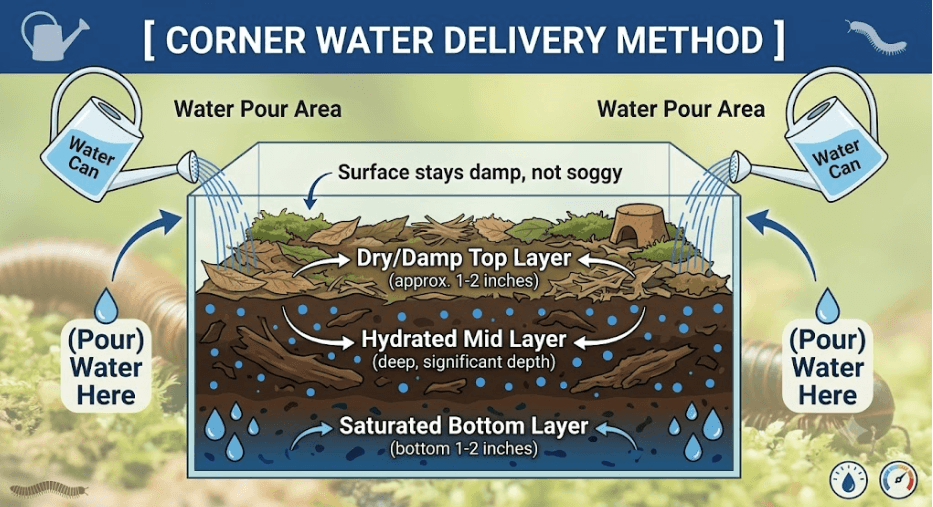
As a rule, keep your substrate at least as deep as your longest millipede. That depth is what gives you a natural moisture gradient — damp down at the bottom where molting happens, and a bit drier up top where they forage. Specially formulated substrate mixes available at Postpods provide the exact balance of decomposed hardwoods and essential nutrients needed for healthy burrowing.
| Substrate Component | Functional Role | Target Ratio (% of total volume) |
| Flake Soil | Fermented base nutrition | 40% |
| Decayed Leaves | Primary surface and subterranean grazing | 30% |
| White-Rot Wood | Vital lignin and cellulose source | 20% |
| Organic Topsoil | Moisture retention and structure | 10% |
Essential Nutrition and Calcium Delivery
Millipedes are scavengers in their essence, so they require constant availability of decomposing organic matter. Oak, beech, and maple leaves comprise the largest share of proper nutrition, and they must always be frozen prior to being put into the enclosure to eliminate any pests that could travel with the leaves.
You can toss in fresh produce like squash, cucumber, or sweet potato now and then as an occasional treat, just don’t leave it sitting for more than a day — uneaten fresh food turns into a mold and pest problem fast.
Calcium matters just as much. It’s what restores the rigidity of the exoskeleton post-molt, and in cases of deficiency, there will be soft exoskeletons and incomplete molts.
- Cuttlebone: Apply the whole or crushed cuttlebone to the substrate layer.
- Calcium Carbonate Powder: Sprinkle lightly onto the leaf litter one time per week.
- Insect Frass: Offers essential minerals along with natural calcium intake.
Temperature, Humidity, and Moisture
Proper environmental controls will help avoid fast drying since the millipedes do not have the waxy cuticle as most insects do. The relative humidity should be 75%-85% in most cases.
The easiest way to regulate moisture levels is by pouring water into the corners of the terrarium, not from above daily. Pouring into the corners gets water down to where they build their molting chambers, while the surface stays comfortable enough to walk around on.
Maintain the temperatures consistent, within the range of 72°F to 78°F (22°C to 25°C). Do not use any heating lamp, as they are excessively drying the substrate. If you have to provide supplementary heating, use a small wattage heat mat on one side of the tank above the substrate level. Heating from below may prove fatal for those millipedes which are escaping from heat.
See also: Building a Strong Digital Presence for Modern Businesses
Co-Housing Dynamics and Isopod Warnings
If you prefer keeping various species in one place, then the conditions of temperature and humidity should be the same for all of them. However, if we consider safety for these animals and for breeding, then separate places should be provided for them.
Do not put your millipedes along with fast and aggressive species like Porcellio laevis and Porcellio scaber. The thing is that they will eat any soft-bodied millipede after shedding its skin.
The best choice for cleaning bugs is springtails (Collembola). They will eat extra molds and food leftovers without affecting soft-bodied millipedes. If you have a bio-active tank setup, providing springtail food, like nutritional yeast or special powdered mixes from Postpods, would ensure that they thrive without affecting the substrate.
FAQ
Are there cohabiting millipede species?
Some species with matching temperature and humidity needs can technically coexist, but sticking to single-species groups is still your best bet. Mixed enclosures just mean more competition over prime molting spots and food.
How thick should the substrate be?
At minimum, as deep as your longest millipede. That gives them enough room to burrow all the way down for a safe molt and to manage their own moisture levels.
How often should I change the substrate in my habitat?
Change roughly half of the substrate every 6-12 months based on the number of millipedes in your habitat. Never do a full 100% replacement — that wipes out the gut-microbiome bacteria the whole enclosure depends on.
Are springtails suitable as tankmates for my millipedes?
Yes, springtails are actually beneficial for your millipedes since they consume mold and decomposing waste before it turns into fungi.
Habitat Mastery and Long-Term Maintenance
All in all, keeping healthy millipedes is easy; you need to mimic nature as much as possible. The decayed hardwood substrate becomes more important compared to any other artificial or non-living substrates, especially during molting, since the millipedes become extremely vulnerable during this process. Take care of the humidity, provide calcium for the enclosure, and be careful while choosing the right tank mates. Just check on your ecosystem every day and adjust to the seasons’ changes.
