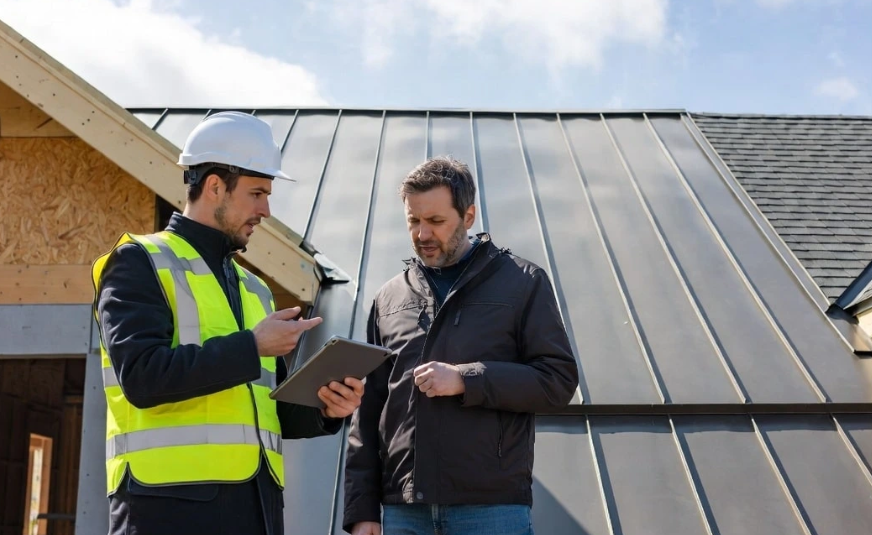
Quick answer: Standing seam roofs use interlocked and raised joints made from metal, which allows for rapid drainage of water as well as resistance to wind uplift. Tighter envelope, cleaner silhouette. Architects specify it on purpose.
Rain doesn’t ask permission before it finds a weak spot. It pools at flat joints, seeps under loose shingles, rots the decking nobody checks until there’s a stain spreading across the ceiling. Seam roofing sidesteps most of that problem by design — the raised seams sit well above the waterline. A steel or aluminum panel run, locked together at 12- to 24-inch intervals, gives wind and rain almost nothing to grab onto. That’s the draw of Seam roofing for architects juggling performance specs and a client who wants the building to actually look like something worth photographing.
Interlocking Panels Cut Water Infiltration
Water moves downhill. Always. Standing seam panels involve mechanically or hydraulically crimped seams raised at 1 to 2 inches from the face of the panels, which remain free of standing water runoff during rains. This is a stark contrast to exposed fastener metal roof panels that have screws punched directly on their faces, which fail after 10-15 years. No face penetrations here at all. Leak call-backs on properly installed systems are rare enough that some manufacturers back them with 30-year weathertight warranties — not just material coverage, the actual seal.
Wind Uplift Resistance Holds Up in Storm Zones
Florida’s Miami-Dade NOA testing has pushed some standing seam assemblies past 150 psf uplift resistance. That’s not a marketing number. The data was collected from wind tunnel tests and static load tests, which are really done by insurance companies. Spacing between clips is very important; it should be smaller near edges and corners where suction is maximum.
Thermal Movement Is Built Into the Design
Metal expands. A 40-foot panel run can grow nearly half an inch across a 100-degree swing between January and July. Standing seam systems use floating clips that let panels slide slightly instead of tearing fasteners loose — honestly, that’s the whole reason the “standing” seam exists instead of a flat lock. Fixed-fastener systems skip this flexibility. That’s often exactly where cracking starts early.
See also: The Best Gadgets for Home Improvement Enthusiasts: An Electric Tools Overview
Extended Lifespan Alters the Maintenance Equation
| Roofs Type | Approximate Lifespan | Maintenance Requirement |
| Shingle Roofing | 15-20 years | Loss of granules, occasional reshingling |
| Fastener Metal Roof | 20-30 years | Replacement of gaskets/screws every 10-15 years |
| Standing Seam Metal | 40-60 years | Periodic seam inspection, little fastener repair |
That gap adds up fast. Fewer contractor visits. Fewer scaffolding rentals. Fewer emergency patch jobs the week after a hailstorm rolls through.
Versatility of Design Without Compromising Practicality
The seam roofing doesn’t have to look like an industrial roofing material. It comes in panel sizes from 12 to 19 inches and can come with any finish from flat matte charcoal to standing seam copper that turns green after a couple of decades. The architects use the vertical lines to make the façade look longer or split a low-slope roof.
- Vertical reveal lines can be used in modern, minimalist, and farmhouse style designs
- Curved or tapered panel runs are achievable with custom fabrication
- Concealed fasteners keep the surface uninterrupted, which just reads as higher-end from the street
Energy Performance Adds a Quiet Bonus
The reflective coating applied on standing seam panels, normally Kynar 500 or any other PVDF surface treatment, reduces heat gain from the attic significantly when compared with dark asphalt shingles. Finishes that meet cool roof criteria may get utility rebates. It’s not the headline reason people pick Seam roofing. But it’s a real one, and it shows up on the utility bill.
FAQs
Is standing seam roofing worth the higher upfront cost?
For most owners staying 15+ years, yes — the lifespan and lower repair frequency make up the difference.
Can standing seam panels go over an existing roof?
Sometimes, with furring strips and a solid substrate check. Tear-off is often the safer call on older decking.
Does standing seam work on low-slope roofs?
Yes. Many systems perform down to a 2:12 pitch once the seams are sealed correctly.
How often do seams need resealing?
Rarely, if they’re mechanically locked. Check every 5-7 years as routine upkeep.
What’s the biggest installation mistake to avoid?
Wrong clip spacing near eaves and ridges — that’s where most wind failures start.
Seam roofing earns its reputation the unglamorous way: by not leaking, not lifting, and not asking much of the owner beyond an occasional glance upward. For a roof meant to outlast two or three renovations underneath it, that’s really the whole point.
