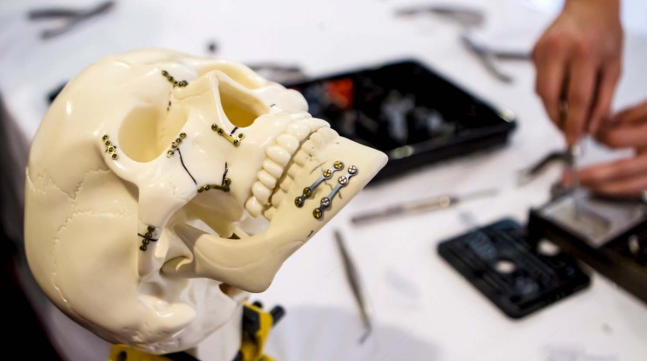
Cranio-maxillofacial surgery involves the treatment and reconstruction of complex anatomical structures involving the skull, face, jaw, and related areas. Because these regions contain important bones, nerves, blood vessels, and functional structures, surgical planning requires careful consideration of anatomy, fixation, implant design, and the patient’s specific clinical circumstances.
Implant systems used in this field are designed to support reconstruction and stabilization in situations such as facial trauma, corrective procedures, and reconstructive surgery. The appropriate system depends on factors including the location of the affected area, bone characteristics, surgical objectives, and the techniques used by the clinical team.
For healthcare professionals and organizations researching available technologies, CMF maxillofacial implants represent one category of specialized medical devices used in cranio-maxillofacial procedures.
What Does Cranio-Maxillofacial Surgery Involve?
Cranio-maxillofacial surgery covers a broad range of procedures involving the skull and facial skeleton. The term combines several anatomical areas, including cranial structures, the midface, jaw, and facial bones.
Clinical situations may include:
- Facial fractures caused by trauma
- Reconstruction following surgical procedures
- Jaw-related reconstruction
- Cranial bone defects
- Midface injuries
- Corrective skeletal procedures
Because each case can involve different anatomical structures, implant selection cannot be based on a single standard configuration.
See also: Life’s Simple Lessons
The Role of Implant Systems
Implant systems can provide structural support during reconstruction and fixation. Depending on the application, systems may include plates, screws, meshes, or other components designed for specific anatomical requirements.
The objective is generally to provide appropriate stabilization while allowing the surgical team to address the underlying clinical problem.
The exact implant configuration is determined by qualified clinicians based on patient anatomy, imaging, surgical technique, and other relevant factors.
Importance of Anatomical Design
The facial skeleton has complex contours. Unlike simple flat surfaces, many cranio-maxillofacial structures have curves, angles, and variations in thickness.
Implant design therefore needs to take anatomical considerations into account.
Factors may include:
- Bone contour
- Available fixation points
- Thickness of the surrounding bone
- Location of important anatomical structures
- Required stability
- Surgical access
A system that works for one anatomical region may not be appropriate for another.
Materials Used in Implant Systems
Medical implants require materials with characteristics appropriate for their intended use. Depending on the implant and application, materials may be selected for properties such as strength, corrosion resistance, biocompatibility, and manufacturing consistency.
Titanium and titanium alloys are commonly associated with many orthopedic and cranio-maxillofacial applications, although material selection varies by product and clinical purpose.
Manufacturers should provide relevant technical and regulatory documentation for their products.
Surgical Planning and Imaging
Modern cranio-maxillofacial procedures often rely heavily on imaging. CT scans and other imaging techniques can provide detailed information about bone structures and anatomical relationships.
Imaging may assist clinicians in:
- Understanding fracture patterns
- Assessing bone defects
- Planning implant positioning
- Evaluating anatomical structures
- Preparing surgical approaches
In some situations, digital planning and computer-assisted techniques may also be incorporated into the surgical workflow.
Fixation and Stability
Fixation is an important part of reconstructive procedures. Plates and screws, for example, may be used to stabilize bone segments according to the surgical plan.
The fixation strategy depends on the location and nature of the reconstruction.
Important considerations can include the number and position of fixation points, implant geometry, screw selection, bone quality, and the forces expected in the treated region.
These decisions should be made by appropriately trained medical professionals.
Importance of Implant Design
Good implant design involves more than appearance. The geometry, thickness, hole configuration, surface characteristics, and compatibility between components can all influence how a system is used.
Manufacturing precision is also important because small dimensional variations may affect how components fit together.
For this reason, healthcare organizations evaluating implant systems may review technical specifications, manufacturing standards, product documentation, and quality-control information.
Patient-Specific Considerations
No two patients have exactly the same anatomy or clinical circumstances. Factors such as age, bone structure, injury pattern, previous surgery, and overall treatment plan may influence implant selection.
This is why online product information should not be interpreted as a substitute for professional medical evaluation.
A qualified surgeon must determine which implant system, fixation method, and surgical approach are appropriate for an individual patient.
Manufacturing and Quality Control
Medical implant manufacturing requires consistent processes and strict quality control. Dimensional accuracy, material traceability, surface quality, packaging, and sterilization-related requirements may all be important depending on the product.
Healthcare providers and procurement teams may also consider:
- Regulatory documentation
- Quality-management systems
- Product specifications
- Manufacturing consistency
- Traceability
- Sterilization information
- Packaging and labeling
Reliable documentation supports informed evaluation of medical devices.
Postoperative Considerations
After cranio-maxillofacial surgery, patients generally require appropriate clinical follow-up. The specific recovery process depends on the procedure and individual circumstances.
Healthcare professionals may monitor healing, stability, swelling, wound condition, and other factors relevant to the operation.
Patients should follow the instructions provided by their surgical team and report unexpected symptoms through the appropriate medical channels.
Choosing an Implant System for Clinical Use
Healthcare institutions evaluating implant systems should consider the intended procedure, anatomical requirements, component compatibility, documentation, quality standards, and availability.
Training and familiarity with the system can also be relevant because successful use depends not only on the implant itself but also on appropriate surgical planning and technique.
FAQs
1. What are cranio-maxillofacial implants used for?
They are specialized medical devices used in procedures involving reconstruction or stabilization of structures in the skull and facial skeleton. Specific uses depend on the implant design and clinical situation.
2. How are implant systems selected?
Selection depends on factors such as anatomy, imaging findings, bone characteristics, surgical objectives, implant specifications, and the surgeon’s planned technique.
3. Are cranio-maxillofacial implants suitable for every patient?
No. Implant selection is case-specific. A qualified healthcare professional must evaluate the individual patient’s anatomy and clinical needs before determining an appropriate treatment approach.
Conclusion
Cranio-maxillofacial implant systems play an important role in modern reconstructive and fixation procedures. Their design, materials, dimensions, fixation components, and manufacturing quality can all be relevant when evaluating medical devices for clinical use.
Because cranio-maxillofacial anatomy is complex, implant selection should always be based on professional surgical assessment, appropriate imaging, product documentation, and the requirements of the individual procedure. Careful planning and qualified clinical decision-making remain central to the safe and appropriate use of these specialized medical devices.
